



In the last six months, we’ve been covering big strategic documents published by the executive branch. We’ve interviewed Dean Ball, the principal author of the Trump administration’s AI Action Plan. We’ve also spoken with Judd Devermont, who authored the Biden administration’s Strategy Toward Sub-Saharan Africa. We’re continuing the trend today, but at a higher strategic register.
I’m joined by Nadia Schadlow, the former Deputy National Security Advisor for Strategy in the first Trump administration and lead architect of the 2017 National Security Strategy. Currently, Nadia is a senior fellow at the Hudson Institute where she focuses on strategy, national security, and industrial policy.
We discuss:
The process of drafting the National Security Strategy
The differences between the 2017 and 2025 strategies
Why time is an underappreciated element of strategy
What to read to understand Russia better
Thanks to Harry Fletcher-Wood, Shadrach Strehle, Rita Sokolova, and Jasper Placio for their support in producing this episode.
For a printable PDF of this interview, click here:
You were the primary author of the 2017 National Security Strategy. That document is a multi-party creation — how does that work?
Strategies should be a multi-party creation in a democracy, because they are about coalition building. But let me step back. What’s the purpose of strategy? Strategists and academics like to use phrases like “ways, ends, means,” answering questions like:
What do you want to achieve?
How will you go about doing that?
What resources are you going to apply?
But a strategy explains the goals of a new president and their importance to a broader audience — in this case, the American people. It generally begins with a set of assumptions — a description of, “Here’s how the world looks today, and here’s why it’s advantageous, or not, to American interests.” Fundamentally, strategy is about explaining to the American people the direction that a country is going in.
If it’s to have any bearing on reality, you need to build coalitions around it. Implementation and outcomes depend upon bringing people together to get things done. No one person can implement very much in this country. We can talk about the ongoing debate about autocracy and democracy — many people think President Trump can and is doing exactly what he wants. But longer-term problems require sustained implementation, which requires coalitions.
You flag the multi-party nature of these documents as a good thing, but it’s often criticized. One critic of the 2025 National Security Strategy called it, “a consensus document produced through least-common-denominator bargaining between its authors.” Would you accept that frame?
I accept that as a criticism of many of these documents. It’s a balance. Strategy-making and articulation is not a science and there isn’t one way or established formula for doing it. When I first got to the White House in 2017, I didn’t get a “how-to” of how you create a strategy. You read different assessments and past strategies, and you develop an idea of how you might construct one.
In a government with competing power centers and viewpoints — whether it’s a Republican or a Democratic administration — you’re going to have a sense of those competing ideas in the document’s contents. Chief drafters can do a better or worse job of cohering them by taking out real inconsistencies or editing certain types of language. But if you’re articulating one point of view that’s not representative of other power nodes in government, you won’t see progress on those issues. People won’t do anything.
Will you talk to me about that set of power nodes? I’m not asking you to gossip, but as you’re producing a document like this, what are the forces you’re trying to mediate between?
Departments see things in different ways. When I was last in government, the Treasury Department was less hawkish on China than other parts of the government. Treasury traditionally represents Wall Street and financial interests that don’t necessarily want to be constrained in their investments into China. The China hawks, probably including me, were more prevalent on the National Security Council (NSC) as well as in the Defense Department. They were concerned that US investments were going toward Chinese firms contributing to the People’s Liberation Army. That’s a good example of interagency debate.
Another example might be within the defense establishment. When I was there, debates went on about how much more of the defense budget should go toward legacy systems or platforms, aircraft carriers or drones. These debates continue today, and they’re important because they get to:
What does future war look like?
Is it going to be dominated by smaller precision drones?
Do we still need aircraft carriers?
Do we need these big legacy systems?
Do we need tanks?
Do we need what’s called “capacity”?
Do we need a lot of stuff, or a few big exquisite systems?
These are the kinds of considerations that are reflected in a strategy.
Where would something like the balance of funding for drones versus aircraft carriers be reflected in the National Security Strategy? Because after that strategy, the executive branch has to produce a National Defense Strategy and a National Military Strategy. These other documents are downstream, and I assume they get more into the nuts and bolts.
You’re exactly right. The debate I described would come out more in a National Defense Strategy, or in subsequent implementation documents. But for the National Security Strategy, we discussed it in terms of how to frame the language to say “more capacity.” I’m not a big user of adjectives, you have to be very careful with them. But in this case, “more capacity” would send a signal about needing a quantitatively bigger military. The specifics would come out later. Sometimes there are signaling words — you might say something about the need to produce more at scale, more quickly, because of the environment we’re facing. Then you might describe that environment. But you don’t want it to be too specific, otherwise you’d have a very long document.
Let’s imagine I’m on one side of that fight. I want to produce way more drones rather than spend money on massive naval systems, and the adjectives in the National Security Strategy lend themselves to my way of thinking. How would I use that to get what I want?
You’d go with the language. One of the lessons I learned when I worked at the Defense Department many years ago was how important the initial talking points are; what’s called in “the paper drop” in government-speak. If you can be the first one to put the piece of paper down with the language, you have a competitive advantage in the interagency process. It’s probably the same in business. There is a power to that, because then everyone else has to respond. You’re creating the template.
Second, it comes down to your principal — the Secretary of Defense, or Commerce, or Treasury — being willing to fight it out at the table, or send their delegates to fight it out. You find some compromise language — or not. Not everyone was happy with every element of the 2017 strategy. I learned the art of how to be polite, get inputs, and consider and balance ideas, but to ultimately take a decision that’s not always popular. Climate change was not mentioned in the 2017 document. That was shocking to people, but it wasn’t a priority for President Trump and still isn’t. It didn’t come up as a major security interest for the United States, which was a departure from the previous administration.
Who else was unhappy about language in the 2017 strategy?
I think there was less disagreement than people wanted there to be. I was always asked, “What were the massive knock-out fights?” There weren’t that many. There was a sense that the document needed to articulate a worldview that was consistent with the President’s — what he had said on the campaign trail and during the first year of his first administration. It did that.
There was pushback by some who focus on Europe. They were concerned that there wasn’t enough mention of the European Union (EU), for instance. These issues seem small and tactical, but they tie to President Trump’s overall view of the EU — an entity that he’s frustrated with, which he sees as not pro-free trade and disadvantageous to the United States in terms of its trade policies. Those are his views, so that emerged in the strategy.
If those critics were frustrated by how the EU was talked about in the 2017 strategy, you should have told them, “Wait till the 2025 one. You’ll get a kick out of that.”
There was a sense that it wouldn’t be seen as a center point of power, so we shouldn’t talk about it as such or mention it much. I learned from that experience that country-mentions are important. Countries wanted to be noted as an American priority.
Almost all National Security Strategy documents — going back to the first of Reagan‘s second term, when it was first congressionally mandated — have a list of regions. Each section — Europe and Africa, and the Western Hemisphere or Latin America, depending on how you slice it — lists priorities and partners. Is the principal motivation there to broadcast our approach to partners, allies, and potential rivals?
Those regions that are mentioned are of strategic importance to the United States. What’s required is a sense of our role in those regions, how we manage them, and what outcomes we want. There’s a traditional way of thinking about regional balances of power, which is articulated in the 2025 National Security Strategy. Generally, we don’t want to see a region dominated by a bad actor — we don’t want the Middle East to be dominated by Iran, Eurasia by China or Russia, and the Indo-Pacific by China.
Countries in the region play a role in balancing power. That concept is very compatible with burden-sharing and getting partners to do more. It also indicates that the US has an interest in keeping those regions stable and balanced.
I want to go back to that list of power centers that play a role in the drafting of this document. We talked about the Treasury and China hawks. What were some of the other power centers you were mediating between as you created this document?
Border security was elevated in the 2017 strategy in a way that it hadn’t been for maybe decades. There wasn’t disagreement about it, but articulating the importance of a non-porous American border was very important. Missile defense played a key role. The idea of protecting the security of the American homeland became what was called the first “pillar” of the strategy.
We had four pillars — core strategic objectives that we described in the document: (1) protect the American homeland; (2) grow economic prosperity; (3) preserve peace through strength — meaning a strong military, but one you hopefully don’t have to use; and (4) advance American influence.
It’s not that other administrations don’t agree with those objectives. But politics comes in, and how you go about doing that differs across, or even within, administrations — maybe even from Trump I to Trump II. The “how” is where the politics get hashed out.
Talk to me about the role of the Department of State. We’ve had several folks on from State (including Dan Spokojny and Judd Devermont) and the Central Intelligence Agency (such as Laura Thomas and Rob Johnston). They’ve often talked about the particular cultures they come out of, and the lenses they bring to bear. How did those cultures show up for you?
The State Department culture manifests through a focus on how the document will be received by respective countries or impact US relationships with a particular country. Whereas the White House culture, and my culture, was, “This is a document that we’re writing for the American people, to articulate a view of what the world looks like from here and what we’re going to do to improve America’s position.” We had this so-called “interagency” process, which is one of the many overused words in Washington.
Why is it overused?
It’s such a blobby word — what does it actually mean? [Statecraft had Dean Ball explain the interagency process, and how he navigated it, in a recent interview.] You can have these talks and talks that are interminable, because you’re trying to include everyone around the table — versus making a decision and finding that balance. There isn’t a formula for that — a lot of it comes down to personality. Clearly the President is not super-interested in the interagency process. It’s not his personality. At the lower levels, it may or may not be going on to varying degrees.
I ran one for the 2017 strategy — I had the autonomy to do that — and I found it to be useful. We literally had the State Department in the room: we would host meetings in the Eisenhower Executive Office Building and invite the State Department, meaning representatives of key offices. I didn’t decide who came — the State Department decided who to send. Same thing for the Department of Defense, Treasury, and Commerce. You sit around the table and work through a particular agenda. But I didn’t host meetings all the time. We had about 12 significant meetings.
As principal author, did you set that agenda?
That was my job, to set an agenda to drive the production of the document. I had the autonomy to do that. In the Trump White House, both in I and II, everyone has autonomy, which can be good and bad.
What would a typical agenda look like for one of those meetings?
There wasn’t a typical one. I asked attendees what they thought about the core structure of the document and there was debate focusing on the four core pillars. At the time, it was, “How do we treat the concept of sovereignty and the nation-state?” That was, and continues to be, a clear theme of both Trump administrations.
Previous documents had been highly focused on the multilateral order that the US helped to shape, which was an effective one. Trump came in saying, “What’s working and what isn’t?” How do you create a set of meetings to address that without it becoming an irrelevant academic process? There’s lots I like about academia, but you have to run a process that has an end point. It’s not just a course you’re taking.
People have strong feelings about that topic and could go off in all kinds of directions. How do you run a meeting with these important stakeholders to get something useful to go write a document?
You ask for inputs and have people come to the table with their views on paper. Two or three pages, not more. “How should we articulate the concept of sovereignty? How should we articulate the problem of jihadist terrorism and its underpinnings?” Ask others around the table — ideally people that you know might have different viewpoints — to present the papers for discussion. That’s the art of running a good meeting: have a clear agenda, stay on time, don’t let one person dominate. That’s useful for readers to have in their toolkits. You want everyone to feel that their views have been taken into account and they’ve had a chance to speak. You always have someone at the table who’s sputtering because they haven’t been listened to. It’s happened to me — I’ve been on the other end.
Did you run these meetings Amazon-style where everyone sits in silence and reads in the meeting, or did you expect everyone to come having read?
Ideally they should have come having read the paper, because it’s not reading time. But a lot of times individuals won’t have the time, so they end up glancing down at it. That’s why you keep the papers short. Most meetings have what we call “the book” — the agenda and the relevant papers. My meetings weren’t with the secretaries or deputy secretaries of the departments. These were working-level meetings of assistant secretaries or deputy assistant secretaries. But it’s the same thing all the way up to the president. You have the book, you have who’s preparing the briefing book. The agenda generally starts with, “The purpose of the meeting is…” We tried to run our meetings that way. General H.R. McMaster, who was the National Security Advisor during that period, ran NSC meetings that way.
At that level, there are two types of meetings. One could be informational — you need to get information out there. The second is to make a decision on a topic. You shouldn’t have meetings that have a lot of other purposes at that level.
Were there parties or agencies that were consistently better or worse prepared to play an active role in these meetings?
There’s a lot of gamesmanship. Speaking out of turn — some of the post-Trump I books talk about it — there’d be these paper drops by the State Department. That meant ignoring everything in the briefing book and coming in with your own agenda, saying, “Here are the PowerPoint slides that we should be looking at now.”
It’s pretty aggressive — you’re the one setting the agenda and they’re imposing their own.
Secretary Rex Tillerson might’ve done a bit of that, as has been written in some of the books. That would make everyone mad — “You can’t do that.” But he thought,“I can do it. I’m Secretary of State. This is a topic that is of big interest to the State Department.” I always see it both ways — it’s part of how to navigate Washington. I assume this happens in other domains. But the stakes are high sometimes. You’re not giving people enough time to prepare their argument, though you could also argue they should be well-versed enough on the issue to make a counterpoint.
In a podcast taped shortly after the publication of the 2017 strategy, you mention how, on occasion, you would circulate drafts as PDFs to make it a bit harder for other people to give you detailed line edits. Are there any other tricks of the interagency trade that you’d suggest?
You have to be careful with that one. But I feel secure about my writing skills — I’m a picky editor — and I didn’t want it to get all gobbledygooked up, where everyone’s throwing in random words and crazy adjectives, like “robust” or “leverage.” Leverage is the favorite verb of the Washington policy community. Things can go nutty — they don’t actually mean anything. You’re like, “What’s a ‘robust defense’ as opposed to a ‘defense’?” I always like asking that. “What’s ‘leverage’?” Leverage was like “seesaw” — it’s an engineering term. Now it’s gone crazy. It’s everywhere. Washington likes to include three verbs whenever it can, as opposed to one.
I encounter this in my editorial work. I like triplets sometimes, but they get beaten to death.
Are all three necessary? Or is it just the last one — because you implicitly need to do one and two, to get to three?
That was why I did it as a PDF. It still allows you to come in and say, “Nadia, you’ve gotten these three things wrong,” or, “You need to say this more clearly.” That’s what I wanted to hear. I didn’t want to have words randomly changed.
What does the national security strategy do for somebody who wants to get things done inside the federal government?
Let’s take pillar one, ensuring that we have a strong border. Page nine says, “Strengthening control over our borders and immigration system is central to national security, economic prosperity, and the rule of law.” The strategy spoke clearly about the need to build a border wall. If you’re the Secretary of the Department of Homeland Security, it gives you the White House political imprimatur to say, “The president said, ‘We need to do this.’”
It’s not that everyone listens. It’s not, “Do this or else you’re off to the gulag.” We live in a democracy. It becomes a way for you to negotiate and gives you the cover you need. It tells people, and Congress, “This is a priority.” Then you get into rolling up your sleeves and figuring out how to do it and how to appropriate the money. That’s not something I did, or that the NSC does. That’s what the departments do. The Department of Homeland Security, Congress, the Office of Management and Budget — they’re the money people. They sit in a room and argue.
To play devil’s advocate, the President said many times in the 2016 campaign, “We’re going to build the wall.” It’s maybe the thing people remember most about the campaign. What does the document do that the principal’s message doesn’t?
There’s a difference between campaigning and putting it on paper. There is a value to capturing ideas in one place, so you have an integrated strategy. It also allows people to say, “You said you want to do all this for border security, but later on, you want to do these other things. How are you going to make the trade-offs, or fund one over the other?” Having a consolidated statement of interests and goals is what strategy is. It allows you to have the arguments about trade-offs, and see if there are inconsistencies. But a candidate’s power is different from the president’s.
Does Congress play a role, informally even, in the creation of this document? Obviously Congress is not formally privy to the interagency process — it’s outside the executive branch completely. But are there ways in which you, or people in your shoes, would get information or have touchpoints with congressional leadership?
The White House has a congressional liaison team [the Office of Legislative Affairs]. You could formally work through them and ask where Congress is on particular issues, or for a sense of how Congress is likely to respond to the language. You play a role, but you have to make sure it’s an informal role, because there are rules about how executive branch officials can speak to Congress. With the permission of the Office of Legislative Affairs, you can go up to the Hill and brief the staffers on the Senate Armed Services Committee on the general lines of argument. Especially after [the strategy is published], you can say, “Here’s the strategy, here’s what we meant, here’s what we said.” So there is a back and forth. But you’re right, Congress does not have any formal role in shaping the strategy — although in the end, they’re a key part of implementation, because they control the purse.
I imagine that informal back and forth with Congress is a bit easier today now that everybody in Washington uses Signal.
Exactly. Or I guess they just use X too.
This administration’s National Security Strategy has key similarities to the one that you principally authored almost a decade ago, and some striking differences in content and in tone. Let’s talk about the tone first.
The tone is definitely different. Every drafter has a style of writing. You know that, because you’re an editor. This document was stylistically different. The 2017 strategy had a more measured tone — maybe not as emotional.
Would you call this one more emotional, more confrontational?
It’s probably more confrontational, more angry — there’s more frustration expressed in this document. It’s organized differently, but many elements are the same in both documents:
Protection of the American homeland,
A concept about how to grow the American economy,
A lot on trade,
How America has been disadvantaged by globalization,
A description of the rationale for tariffs, and the role they would play,
The “peace through strength” element — a strong military to deter; and,
Concepts of balance of power and power mattering.
I was glad to see recognition of allies and partners being quite important in this one, especially in the Indo-Pacific. I know the Europeans were not that happy with this 2025 document.
That’s one way of putting it.
These strategies often introduce strategic concepts, or new language for a concept. The second Obama strategy talked about “strategic patience.” The Bush doctrine was a feature of the first George W. Bush administration’s strategy. Did you lean on any specific language or concepts in the 2017 strategy that you don’t notice in the second Trump strategy, or vice versa?
I think there’s consistency, even though this one used different words. For example:
In 2025, “flexible realism” was used. We used a different version of that in 2017. But realism definitely comes through in both, maybe with adjectives before it.
The idea of the nation-state as a primary actor, and sovereignty being important and elevated, is in both.
Deterrence becomes important. To go back to our discussion about language, in this case the two words matter. “Deter,” and if necessary, “defend” or “fight.” That’s where it’s okay to use a couple of different verbs, because you want to deter — that’s the primary purpose. If deterrence fails, you want to have the capability to defend yourself, or punish your adversary. So having a strong modern nuclear deterrent comes out in both documents — the importance of reinvigorating our nuclear enterprise.
I did not go and do the ChatGPT comparison. To our earlier point about how you can end up in these very esoteric analytical discussions — I’ve avoided it.
I have asked a couple of LLMs for their perspectives on the comparison. You noted many of the similarities. I agree there’s consistency — after all, it’s the same president. I think there is an argument that this NSS is closer to the perspective of President Trump than the 2017 one, at least tonally. It feels more like a Trumpian document. Am I crazy for thinking that?
I don’t think so. The President has a certain way of communicating and a voice — both literally and figuratively — that probably is more evident in this 2025 strategy. There has been criticism of the 2025 document for not being as China-hawkish as the first one. My response has been, “Yes, China is not called a strategic competitor.” The 2017 document used that term “strategic competitor.” That was important at the time, because it was a phrase that people initially were like, “Oh no, we should rephrase.”
Readers younger than me might not have a sense of how striking that was when it came out — that you were choosing China as the single biggest threat facing America.
That was President Trump — that’s how he was articulating the China problem at the time. The second document reflects that he wants to leave opportunities for negotiation open — not to poke, poke, poke. I think the second White House chose to use different language. Strategies don’t stay the same — nor do people. Their thinking evolves. But if you look at what the document says — when it speaks about predatory state-directed subsidies and industrial strategies, when it discusses unfair trading practices, job destruction, and de-industrialization threats against our supply chain — those are pretty strong statements, and they’re not geared toward Spain or Italy. It’s obviously China.
That’s without even getting into the South China Sea and our commitments to Taiwan. I did notice that criticism of this year’s strategy, which I thought was a bit strong after reading the document. It seemed more like a matter of emphasis or tone than a major shift in the approach to China.
That’s a good point, because the language on Taiwan is very strong. It might even be stronger than it was in 2017. It definitely articulates a status quo and that we don’t want to see a change, which means we don’t want to see China invade or try to change the status quo. It presents the importance of Taiwan more broadly beyond being a center of the most important economic drivers, meaning semiconductors and ships. It also discusses the importance of growing and keeping our military strong. We’re doing that because we see China as being the main peer competitor in that domain.
Iran is briefly mentioned in this most recent one. Operation Midnight Hammer had already happened at the time of publication, so that’s mentioned briefly. North Korea is not mentioned at all. What’s up with that?
I don’t know. Is it an omission due to process and not going to someone who might have asked “Oh, where’s North Korea?” Or is it deliberate? Then there’s a reason behind it, which might be about keeping open the opportunity to communicate — not knowing the direction that things are going to go. It’s a super-complicated problem set that we’ve had limited success in dealing with, even though the first Trump administration was the most forceful in decades, with a maximum pressure strategy. I’ve moved toward thinking it’s more about keeping options open. Maybe there’s not a settlement internally on how to address it. It could also be that things are still being debated.
Is there anything else that’s not totally intelligible to you, whether or not you’re critical of it?
It’s pretty clear. The North Atlantic Treaty Organization (NATO) is a critically important alliance. It’s one of the most successful features of the post-World War II order, and one that should continue to exist. It would be very difficult to recreate it. Why would you not want to keep it strong? Now we’re debating how to keep it strong. Trump’s would probably argue that toughness on NATO made the alliance stronger. But we do want to remember that these are our allies too.
I’m not going to make you talk much about Greenland — by the time we publish this, the facts on the ground may have changed — but it seems very stupid to me, and counterproductive.
It’s counterproductive. Everyone likes to take one episode and say, “Maduro means we’re going to do this in Iran, and Iran means we’re going to do this…” But if you can achieve your outcomes — improving the US and NATO security posture in that region, access to critical minerals, all of the things that the President wants to do — without the use of military force, why wouldn’t you take that course of action?
You could argue that in the case of Venezuela — this is what he argued, and I’m sympathetic to it — we were being infiltrated by drugs and cartels. You can make an argument for use of force. [Statecraft recently published a detailed discussion of US action in Venezuela]. You can definitely make an argument for use of force vis-à-vis Iran. The strikes there — you’re not going to achieve that with negotiations, diplomacy, and changed posture. I understand the impetus to say, “Get serious about Greenland.” But you can achieve your outcomes without the use of military force. So I don’t completely understand it.
In the past year, you’ve written about a cluster of related ideas: strategic depth — having the time and flexibility to choose your response to circumstances — and time, as an underrated dimension of strategy. Talk to me about your intellectual interest in this cluster of ideas, then help us understand why “strategic depth” matters.
I’ll start with time, because that is something that animates me. It’s both obvious and amazing how long it takes to get things done. By not considering how long something takes from start to finish, we’re undermining confidence in our democracy. We’re creating cynicism. I think it’s a huge part of the dynamic domestically too. We’ve been saying the same thing about the reform of America’s public schools for 30 years, and things aren’t getting done. We’ve been saying that we need to rebuild our infrastructure. We’re rebuilding part of it — whether it’s the highway to get to John F. Kennedy Airport or some other — but it’s taking years and years. We conveniently avoid this question of time.
I think it’s hurting us domestically. It’s letting our politicians and leaders off the hook. It’s definitely hurting us internationally, because organizations like the United Nations have spent 30 years talking about the same sets of problems. This article in The Atlantic was inspired by “The Forgotten Dimensions of Strategy”, an article written many years ago by a great military historian named Michael Howard.
Which is also a very clear read, like the 2025 National Security Strategy.
It just says, “We like to talk about strategy at the big level” — in some ways, the way you and I have had this conversation — “and it’s fun. But there are also these concrete inputs: logistics, you have to be able to get from here to there; what people think about the unfolding of a war — the forgotten dimensions.” In rereading it, I thought, “Time is a forgotten dimension.” Or it’s not put front and center.
Today there’s an opportunity, with all of the data we have, to do that. We no longer have the excuse of saying, “We don’t know how long it takes to build a new mine from start to finish.” We do know — it takes something like 16 years, at least. We can also say, “We know how many regulations are involved in that.” We can use AI to do that. We can do things differently today if we want to.
I’m very sympathetic to this view, because much of our work at IFP is trying to reduce the amount of time it takes to build things in America. We’re pretty fixated on the amount of time it takes to run a clinical trial and test a new drug. But why is this a forgotten dimension in the Blob of national security strategy? I would naively assume this would be an obvious question — the American military is famously focused on logistics. Why do people in your world need to hear about the importance of time and strategy?
Because it shouldn’t take decades to develop a weapon system, or integrate something into our Defense Department, or negotiate a deal.
How do you solve that? You evaluate time as a key input. You do a Gantt chart. I did an essay about the electrical vehicle debates during the Biden administration. The title was, “We Gantt do this” — a bit hokey, but it works. Gantt was an engineer in the early 1900s. Many readers in the private sector will know the Gantt chart. It’s a great concept: “How do you get from A to Z? And what’s the timeline?” We need to do that more systematically in the national security and foreign policy space. Then you understand what the obstacles are, what regulations are impeding you, and where you need to focus your action. The more you input this as a core component, the more you focus on it, and are held accountable to it. There’s room for an organization like yours to help answer that question. I don’t know the complete answer of, “What are the approaches to improve this?” but there are probably five or six specific ways that you could do this in the Food and Drug Administration process. I bet people would have an answer.
You’ve given me a wonderful excuse to link some of our work in the show notes without feeling like I’m abusing the reader.
But it’s true. What’s the right combination of things where you could make a difference here? There’s probably not one answer, but the point of that article was to say, “We talk about ways, ends, and means. Where does time fit in? How do you evaluate one project over another if you put time into it?” We like to use this term in Washington, “The perfect is the enemy of the good.” You develop this perfect weapon system — versus one that is pretty darn good and can be produced quickly at scale. Time matters there. You’re making a choice, maybe taking a risk, but saying, “In this case, the speed of acquisition and deployment is more important than the perfect precision of another system.” That’s a good example. It helps you make trade-offs.
I want to change gears one more time, and ask you about your background in Soviet studies. Almost by happenstance, a big pile of the reading I did last year was Russian, or about Russia. If I want to understand Russia, historically and today, what would you recommend I read?
You’re dating me, because as soon as you say “Soviet studies,” you’re like, “Wow, she’s old.” That major doesn’t even exist anymore.
Understanding a country requires a combination of the culture, the history, and the political science. With Russia especially, it’s always important to read Russian literature — the classics. Even in today’s discussion about Ukraine, people will point to key Russian nationalist thinkers and how they think about Ukraine as being very important for the way Putin thinks about Ukraine. As much as it is wrong, it provides them with a rationale that we should understand.
When I was studying the Soviet Union, the two key authors were Adam Ulam and Richard Pipes.
Pipes is very high on the list for this year.
Now I read Stephen Kotkin. He’s wonderful. He has done some great podcasts.
The third volume of Kotkin’s Stalin biography is coming out this year.
I’ve been rereading a bit about Tukhachevsky — a famous Soviet General who was killed by Stalin after articulating some important and interesting concepts.
The worst thing that can happen to somebody like you in the national security space is that you come up with some important new concepts…
And you’re hauled off. I realized how many of the Soviet General Staff were killed. Depending on who you read, it made a material difference in the war. But I’ve been reading about him because, to go back to the strategic depth point, that is a concept about time and space — having enough territory to keep an adversary busy until you have time to counter-attack. The best example is what happened with Napoleon’s invasion, and then the Nazi invasion. There’s this great chart which depicts Napoleon’s invasion. It’s called the Minard graph. It’s one of the most famous graphic depictions of a whole bunch of things.
There’s that Edward Tufte book, The Visual Display of Quantitative Information. It’s a touchstone for one of my colleagues and for the way we think about our work here at IFP. I’m glad you’re bringing this up.
The Minard graph depicts Napoleon’s army going into Russia. It’s a big thick line going in, depicting 400,000 troops — and a very thin black line coming back out, showing that something like 10,000 troops survived.
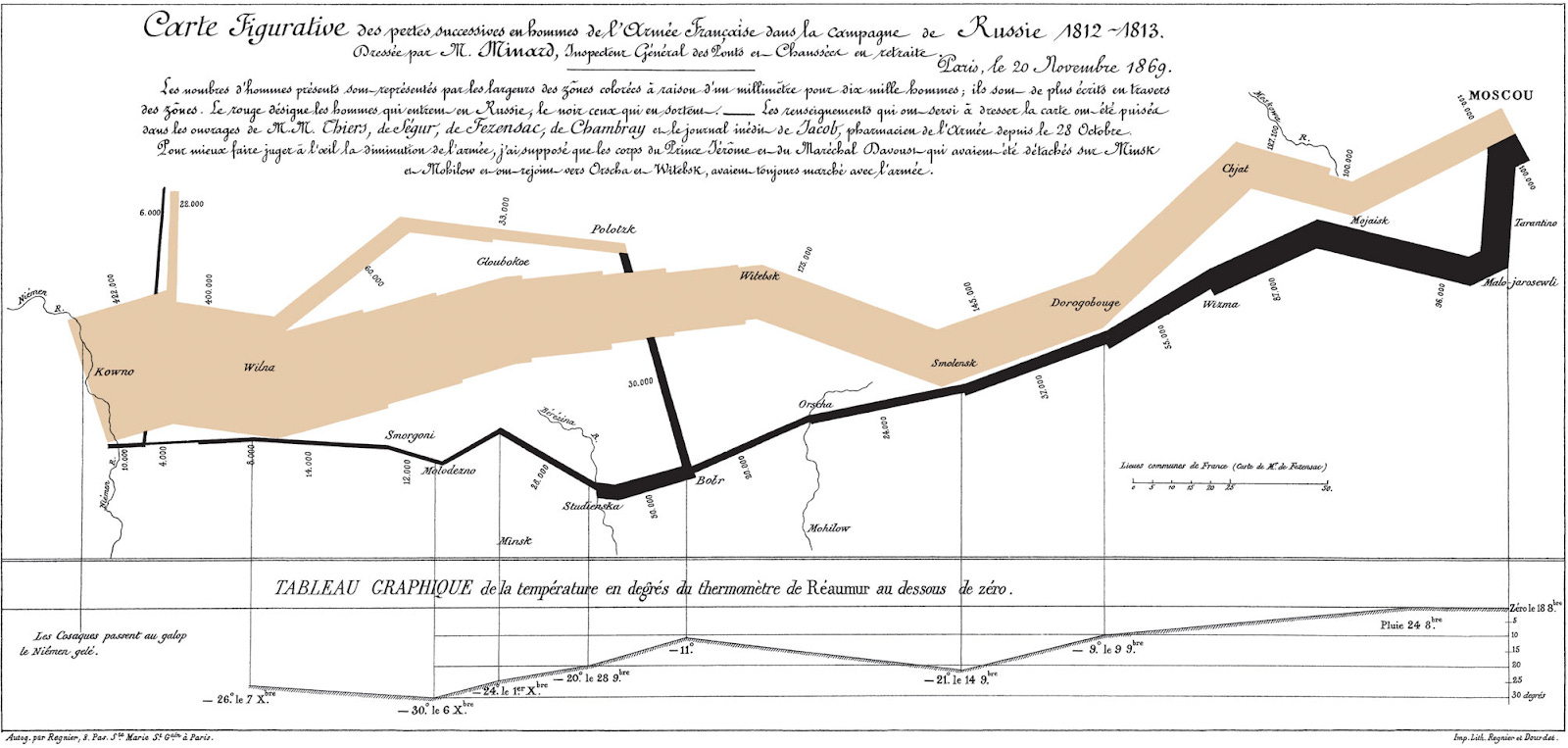
They were able to draw in the troops, use the territory to regroup, and have the time to counter-attack.
People who want to understand China often read the science fiction book, The Three-Body Problem. I think it’s useful to read some contemporary Russian authors to get a sense of what society is like today. But I’ll stop there — let me know what you’re reading.
The three books I have on my list for this year are Richard Pipes’s book, The Russian Revolution, which you mentioned; Dostoevsky’s Demons, which is one of those classics; and Secondhand Time — I hear Svetlana Alexievich is an excellent interviewer, tracing the fall of the Soviet Union. I could use advice on how to interview better, but anything else that you’d put on my list from the modern era, I would happily throw on.
You need to have a sidebar book club here.
I need one more project, is what you’re telling me.
Exactly.


