


If you’re a president who wants to regain managerial control of the federal bureaucracy, you’re faced with a problem: some of the most intuitive solutions make the problem worse. Take the cases of Kristi Noem and Howard Lutnick, two Trump Cabinet Secretaries who tried to aggressively make their marks on their respective agencies (Noem is now out at DHS, while Lutnick remains at Commerce). Both tried to impose formal, procedural constraints on the civil service upon entry, and both experienced political setbacks as a result.
In March, it was reported that Noem had a policy of personally reviewing every contract in the department over $100,000 — as a result, over 1,000 contracts were left pending, including search-and-rescue deployments during the Texas floods. Noem’s successor quickly reversed that policy. Lutnick imposed an identical $100,000 threshold at Commerce. It was reported that the National Ocean and Atmospheric Administration was left unable to function while it waited for 200 contracts to be approved. Or look at the EPA, where staff were ordered to submit a one-page DOGE justification for any expense over $50,000, fileable only between 3 and 6 pm ET, on top of the normal procurement paperwork. Separately, research at 11 EPA labs halted because new lab purchases weren’t being approved.
In this newsletter, I’m always trying to find places where history rhymes. As it turns out, many of the moves to get control of the bureaucracy from this admin — especially the idea of DOGE-style constraints on individual civil servants — are not especially new. The Plot That Failed: Nixon and the Administrative Presidency is a slender book written by a Richard P. Nathan, who served in several senior roles in Nixon’s first term.1 2
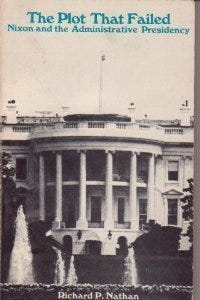
Nathan begins the book with a line from Machiavelli:
“When you see a Minister thinking more of himself than of you, and in all his actions seeking his own ends, that man can never be a good Minister or one that you can trust.”
That kind of principal-agent problem is what Nathan’s book is concerned with: How can a president who wants to manage the federal bureaucracy actually do that? And what are the failure modes of the various approaches a president can take?
Toward the end of Nixon’s first term, a cluster of the president’s closest advisors, including Chief of Staff H.R. Haldeman and Domestic Advisor John Ehrlichman, don’t trust the “ministers” of the civil service. So they settle on a more active managerial approach to the federal bureaucracy: they “did decide sometime in 1971 or 1972 that they would have to take over the management of domestic affairs to achieve the Administration’s major policy objectives. Undoubtedly, this decision was partially a reflection of the success of Henry Kissinger’s parallel operation to win effective control over the machinery of foreign policy.”
The book refers to this approach as the “administrative presidency,” and it has some key points of comparison with today’s presidency. The administrations learn the same lessons, and adapt their behavior in the same ways.
Nathan’s conclusion, more or less, is this: there is a basic set of tools that energetic presidents like FDR, Nixon, and LBJ can reach for to wrangle the civil service into alignment. These tools can work. But they tend to come with tremendous costs. These costs come in multiple forms:
Wasted time, as the White House’s internal bureaucracy gets consumed by procedure and administration.
The destruction of other managerial tools. If you empower White House staff to micromanage an agency, you disempower your Cabinet secretaries.
Epistemic or informational challenges, as the White House becomes less able to change its mind when faced with new information.
Paradoxically, less executive time for strategic questions, and more time on bureaucratic minutiae. Operational trivia floats up to the top, and strategic or philosophical questions sink down.
Nathan’s book is a detailed account of how Nixon’s administration discovered these costs.
Frustration with the conventional Cabinet
Nixon entered office in 1969 at a time in which, like today, both sides of the aisle shared widespread dissatisfaction with the performance and efficacy of the federal government. This was most obvious in the rise of movement conservative politicians like Barry Goldwater, but it was also visible in the success of George Wallace, who slammed wonks and federal bureaucrats. Liberals were chiming in too. The ideas of “delivery problems” and “performance gaps” were both in the air as liberals grappled with the flaws of Johnson’s Great Society.
Nixon’s big push in the first term was to “Provide policy coherence and new direction in domestic affairs.” But Nixon, like all other first-term presidents, was learning on the job. Nathan stresses this fact of presidential life. Presidents come to office with only a vague idea of how they actually want to operate and manage the bureaucracy in spheres domestic, foreign, and economic. They find this management task extremely difficult. It’s not just difficult to wrangle agencies at a distance: even the task of how a president “can organize his office to have his advisers develop policy alternatives and present them to him in a cogent and understandable fashion” is a tall order. Developing coherent and plausible policy ideas is hard enough, and then a president is tasked with the challenge of implementing those policy ideas.
Nathan argues that some of this difficulty is native to every presidential administration: “The flow of events in domestic affairs followed an increasingly logical and coherent pattern, reflecting the unique learning process of the American presidency.” And some of the difficulty was because of instincts that came from the principal himself, like, “as in so many areas in the Nixon years, a strong tendency toward White House heavy-handedness.”
At the beginning of the presidency, Nixon structured his White House more or less as Kennedy and Johnson had theirs. Cabinet officials were selected “in the conventional manner,” meant to placate the party’s regional interests and check factional and geographical boxes. One of Nixon’s picks, George Romney, had been his main primary opponent, while several others were former governors with national recognition. Nixon purportedly hadn’t met two of his Cabinet secretaries before winning the election.
In his first term, Nixon’s Cabinet members “entered on their appointment into an almost ritualistic courting and mating process with the bureaucracy. They were closeted for long hours in orientation sessions with career program officials, the purpose being for these career officials to explain to them program goals and accomplishments and to warn them about the need for support from powerful outside interests.”
In domestic policy, the White House prioritized developing legislation, and more or less let Cabinet secretaries choose and supervise their own political appointees. As often happens, Cabinet officials grew to identify with their agencies. Ehrlichman quipped in 1972, “We only see them at the annual White House Christmas party; they go off and marry the natives.” This began to rub raw, and tensions grew between Cabinet officials and the White House.
Congressional committees and interest groups are often partners, together with the bureaucracy, in the “triple alliances” that develop against the administration’s priorities, what another Secretary of HEW referred to as the “not so holy Trinities,” and what the political science literature calls the “iron triangle.” Political scientists have long observed this dynamic. See David Truman in 1958: “a skillful department head who maintains strong support among the interest groups affected by his agency, and among members of Congress, can be virtually free to ignore the preferences of the Chief Executive.” JFK’s adviser Ted Sorensen made much the same point in his Decision-Making in the White House.
Against the bureaucracy
The Nixon White House attempted at first to manage through the working groups passing legislation to congress, but was blocked out by the iron triangle. This approach suffered, in part because a Democratic Congress stifled much of the agenda.
Nixon began to develop a sense that much of the federal bureaucracy was nonfunctional — that headcount was much too large, and paperwork demands were outweighing real, objective-oriented work. After his Counsellor for Domestic Affairs gave a speech describing federal programs as “half-smothered in paper,” Nixon circulated the text of the speech with his own comments added on. Nixon said the speech “demonstrates the need for massive personnel cuts in all areas of government.” He added, “I particularly agree with his implied conclusion that one-half of the time of government officials is spent writing papers to each other.”
White House aide Michael Balzano summed up feelings about the federal bureaucracy in June 1972 in the following terms. “President Nixon doesn’t run the bureaucracy; the civil service and the unions do. It took him three years to find out what was going on in the bureaucracy. And God forbid if any President is defeated after the first term, because then the bureaucracy has another three years to play games with the next President.”
The conventional cabinet picks had “married the natives,” Congress was stonewalling Nixon’s legislative agenda, and the President was growing frustrated. Advocates of the public administration theory of the presidency, says Nathan, “had been urging that the president himself play a stronger role as a manager of the Executive Branch and that his principal aides in the Executive Office of the President be involved with him in this endeavor.”
There have historically been two strategies for executing this stronger management. One is expanding the Executive Office of the President — the White House staff itself — and empowering those staffers to more aggressively manage agencies themselves. The other approach relies on choosing Cabinet-level leadership the White House can trust, then giving those leaders authority and mandates to act on a long leash from the White House.
The two strategies do not go well together. As Nathan says, “The President must choose.” This is the same perspective OMB Director Russ Vought relayed to me in 2024 (before he was reappointed in Trump II):
“There are two views about how to run the executive branch. One is the Don Devine approach, where the president just deals with Cabinet officials [who are] expected to interpret and then flow it down. Then there’s the FDR or Nixon approach, the modern view, which is that you’ve got to use the tools of agencies like OMB.”
Nixon tried the second strategy: increased White House control over agencies, routing around Cabinet secretaries. Cabinet-level meetings on domestic policy became less frequent about 6 months into the first term, and White House officials started entering into the picture more forcefully. “Under Ehrlichman as executive director of the Domestic Council, the new technique of the White House ‘working group’ was adopted.” It included representatives from multiple agencies, and met “5 to 6 hours a day every day for 2.5 months.”
Direct relationships were established between White House and agency officials well below the secretary. This made it very difficult for the secretaries of agencies to keep a handle on the process. Much like DOGE is technically an office within the White House, but has embedded its staff in various federal agencies, the Nixon administration attempted to develop lines of management to the agencies that routed over or around the formal chain of command.
This had its downsides. As several cabinet secretaries had predicted, it led several times to policies being rolled out and then reversed. When he was fired in 1970, Secretary of the Interior Hickel complained the President was “isolated just sitting around listening to his staff.” Hickel said sometimes the White House would send him “letters opposing proposals he had made, and that the letters were signed by people he had never heard of.”
Nathan says, “On occasion Cabinet members were completely left out of White House deliberations… until plans were fully formed. Access to the President became difficult to obtain and less frequent.” OMB grew rapidly to 700 staffers.
In addition to creating more policy churn, this strategy from the White House also bottlenecked the White House itself. This was also not a new phenomenon. In the Johnson administration, Secretary of HUD Robert Wood had described the danger that occurs when the White House bureaucracy becomes too invested in operational matters in individual agencies:
“...Operational matters flow to the top — as central staffs become engrossed in subduing outlying bureaucracies — and policymaking emerges at the bottom. At the top minor problems squeeze out major ones, and individuals lower down the echelons who have the time for reflection and mischief-making take up issues of fundamental philosophical and political significance.”
And finally, by building larger White House teams to own a cabinet agency’s behavior, the White House accidentally made its Cabinet secretaries more recalcitrant. Pace Nathan:
“When a junior White House staffer calls a career expert in an agency, the relationship that they develop offers wide latitude for agency personnel to develop their own lines into the White House. This only adds to the problem of isolating the Cabinet secretary. Such relationships reinforce the tendency for the secretary and his close associates to draw up ranks and act on the basis of we versus they — they being the President’s staff. The bigger the White House establishment, the harder it is to avoid the classical adversarial relationship from taking hold and becoming dominant. As the counter-bureaucracy of the executive office grew and prospered, President Nixon’s early concept of a strong, independent role for his Cabinet officers increasingly was undermined, and deliberately so.”
A new approach
By 1972, there was growing concern that the counter-bureaucracy technique was not the answer. “As the White House became more and more involved in routine administrative matters, the time and energy it had to devote to truly important policy issues was correspondingly reduced… Moreover, the supply of talented aides for the White House who understand the substance of domestic policy is limited… As the White House staff grew, its general caliber declined.” The White House simply could not find enough talented and loyal staffers to get a handle on domestic policy issues.
To deepen one’s hold over tenured program specialists with close working ties in established functional power systems is a highly specialized management task. Many inexperienced appointees of the Nixon Administration from private industry found this out the hard way and ended up frustrated and leaving, or found themselves increasingly drawn into the subgovernments of particular functional areas of federal spending.
Instead, in his second term, Nixon began looking for more direct means of exercising authority over the domestic bureaucracy. The president would put his own trusted appointees in positions to directly manage key elements of the bureaucracy, without elaborate White House or EOP staff machinery to encumber their efforts. Ehrlichman made it clear what he was looking for in new appointees: “When we say jump, they will only ask how high?” Loyalty among rank and file political appointees was seen as a prerequisite to getting control of the agencies.
Here’s Nathan:
“...The new order of march, in short, was to take over the bureaucracy and take on the Congress, to concentrate on administrative steps and correspondingly to downgrade legislation as the principal route for bringing about domestic policy change. No longer would the Cabinet be composed of men with national standing in their own right who were in a position to go their own way and were disposed by past experience to do so. Unprecedented changes were to be made in the designation (and removal) of appointed officials and in the assignment of their duties. The President’s men — trusted lieutenants, tied closely to Richard Nixon and without national reputations of their own — were to be placed in direct charge of the major program bureaucracies of domestic government for the second term.”
Nixon roadtested more applause lines about government bloat in his speeches: “I honestly believe that government in Washington is too big and is too expensive… We can do the job better with fewer people.” The parallels to the current administration are clear enough.
The new strategy moved many lower-level White House aides to top level management. Many were trusted associates, “not luminaries themselves.” Others were removed from their positions for insufficient alignment. Secretary of Commerce Peter G. Peterson was removed, partially because of his “tendency toward strong argument within the Administration.” Peterson was quoted as saying he had failed his physical: “his calves were too thick and he could not click his heels.”
“By deploying his appointees as politician-managers in line positions, Nixon… was trying to move the line between policy and administration.” Political scientist Richard Neustadt had written that the power of the President is the “power to persuade… to bargain.” This was also the received understanding of the presidency when I was a political science major undergrad. Nixon attempted to change that.
Nixon also attempted to reframe the power of the purse, with techniques that this administration has explicitly borrowed. The budget for FY 1974 proposed significant cuts, in two ways: 1) appropriations requests well below levels of the previous year, and 2) “a series of budget impoundment actions.” The purpose of the latter was to use presidential impoundment authority to cut program levels, and in some instances, completely eliminate particular programs. Such use of the impoundment power was unprecedented. In the past, the impoundment authority had been used most of the time to delay funding for particular capital projects where for various reasons previously approved plans could not be carried out on schedule. The President’s budget message said these budget cuts, taken together, were necessary to avoid a tax increase and to curb inflation.”
There were also more direct parallels to the DOGE approach. In 1973, Nixon assigned Howard Phillips, young firebrand, to abolish completely the Office of Economic Opportunity, on the argument that since it was completely contained within the executive office it could be abolished directly by the executive, without going through the formal “Reorganizational Act” procedure (in which Congress has 60 days to disapprove an org change).” Phillips’ “exuberance in his task appeared to exceed White House expectations”: he said he would move so quickly that “no one would be able to put Humpty-Dumpty together again.” It’s not so far off “feeding USAID into the woodchipper.”
The death and life of the administrative presidency
By spring of 1973, of course, the dream of the administrative presidency was dead. Watergate became the only political story in America. Ehrlichman was forced out of the White House a year before Nixon resigned, and in the intervening year the White House struggled to maintain any control of domestic policy as it focused on staving off impeachment. The clock ran out on an ambitious attempt to reshape the 20th-century relationship between the president and the rest of the executive branch. The aftershock of Watergate meant subsequent presidents, until Trump, didn’t try the same aggressive tactics, to the same extent.
But this has been a project taken up by presidents well before Nixon, and it would continue after him. The parallels to Trump are obvious, but you can also look to connections further back. In 1936, FDR appointed his own committee on management, the Brownlow Committee. It submitted a report the following year that emphasized the need for a strong, fully centralized Executive Branch, in which it waxed grandiloquent:
“Those who waver at the sight of needed power are false friends of modern democracy. Strong executive leadership is essential to democratic government today. Our choice is not between power and no power, but between responsible but capable popular government and irresponsible autocracy.”
Roosevelt approvingly cited the report as highlighting that “The present organization and equipment of the executive branch…defeats the Constitutional intent that there be a single responsible Chief Executive…under these conditions the Government cannot be thoroughly effective in working…for the common good.”
A decade later, the first Hoover Commission called for “a clear line of command from top to bottom.” About a decade after that, a report to President Johnson noted, “Top political executives… preside over agencies which they never own and only rarely command. Their managerial authority is constantly challenged by powerful legislative committees, well-organized interest groups, entrenched bureau chiefs with narrow program mandates, and the career civil service.”3
After Johnson, Nixon, and after Nixon, Trump. There are two big takeaways for me from Nathan’s excellent little book. One is that there has been very little innovation in tactics to control the administrative state from the White House. The big ideas have tended to come from lawyers, with the rise of the Federalist Society. But inside the White House, the same old instincts are as attractive as ever, and their failure modes haven’t changed.
The second takeaway is that many of the Trump administration’s struggles to get hold of the bureaucracy, despite its avowed interest in doing so, come from what Nathan makes clear: you can’t both rely on loyal Cabinet secretaries, and also have White House staffers constantly overruling them. The latter actively undermines the former. Future reformers should remember Nathan’s word: The President must choose.
First the assistant director of the Bureau of the Budget (later OMB, the nerve center of the federal government). After three years there, he spent a year as Deputy Under Secretary of the Department of Health, Education, and Welfare. He returned to Brookings after the 1972 election and the earlier defeat of the administration’s welfare reform plan.
Thanks to Nathan Pinkoski for the book recommendation. Pinkoski has written some of the more influential and interesting Nixon revisionism of the Trump era.
Final report of the President’s Task Force on Governmental Organization, June 1967, unpublished.
I find it interesting in an American context that there is never talk of _reforming_ the bureaucracy. Joseph Heath has written a bit on this, in particular his arguments for the professionalization of the civil service in a US context by comparison with Canada I think hold a lot of weight. It's in the same vein as Garrett Jones 10% less democracy idea. That you might be able to improve the civil service by removing political appointees. Heath's book The Machinery of Government: Public Administration and the Liberal State, is maybe the only source I'm aware of that at least tries to address this issue.
Nathan's avowed intention to "downgrade legislation as the principal route for bringing about domestic policy change" rather gives the game away here. This is an anti-constitutional and tyrannical intention, and it is a very good thing that the structure of the federal government frustrates it. Domestic policy should be set by laws passed by Congress; the presidency, in that sphere, should be a mere functionary magistrate taking care that those laws be faithfully executed. That is how we fulfill the clear intent of the Framers and it is also how we prevent the country from devolving into elective dictatorship. Never has that been clearer than in the present administration.